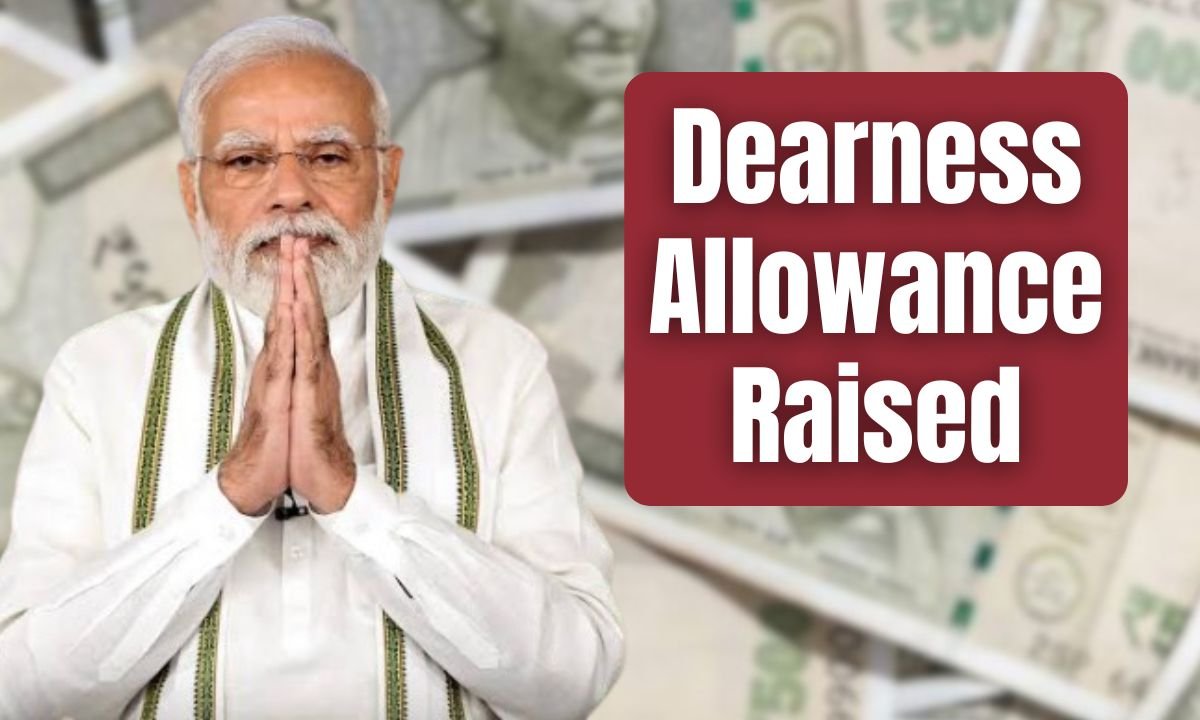
The central government in a recent announcement has decided to increase the Dearness Allowance (DA) rate for its employees and retirees from 53% to 55% of their monthly basic pay/pension, with effect from January 1, 2025. Though small, the hike in DA will still play an important part in monthly incomes, thus, trying to somewhat balance the overall effect of inflation and living costs.
Reasons for Increase: Inflation and CPI-IW Patterns
DA is revised at regular intervals according to the current situation with the cost of living that is being measured through the All-India Consumer Price Index for Industrial Workers (CPI-IW). As inflation and price pressures went up, the government responded by raising DA to safeguard the purchasing power of the employees and pensioners. This increase is a part of the upward revision in DA under the 7th Central Pay Commission (7th CPC), which uses CPI-IW data to decide the increments every six months.

Who Gets the Benefit: Both Employees and Pensioners
The increase to 55% provides a wide range of benefit to the categories of central government employees—throughout ministries, departments, and public sector organizations—and also to the category of pensioners since DA (or Dearness Relief, DR) is equally applicable to both. For example, an employee with a basic salary of ₹30,000 would get an extra ₹600 per month (before tax) due to this increase. The pensioners will be treated in the same way by an updated DR, thus assisting them in mounting their daily expenses.

What It Means in Practice: Income Cushion but Not a Windfall
The revision comes to the rescue of the workers by ensuring that their net income would be equal to the inflation rate so that there would be some free board against the price increase of the necessities like food, fuel, and electricity, etc. Nonetheless, as the increment is on the lower side (2 percentage points), it does not come across as a huge pay hike rather more of a cost-of-living adjustment. The new DA facilitates dealing with the burden of monthly obligations, but not much in terms of savings or increasing one’s purchasing power in the long run. Most likely employees and pensioners would still need old age planning with respect to their incomes, especially with an eye on the high inflation rate.

What’s Next: Watch for Future DA/DR Hikes
The DA is recalculated every half year — in practice in January and in July — on the basis of CPI-IW figures. With the current inflation rate it is very likely that further uplifts will take place. There are some forecasts that during the next 6-12 months the DA/DR will go beyond the level of 58-60%. Among the various factors, one is the 8th Central Pay Commission (8th CPC) that has intrigued the employees the most as to what will happen to the DA — whether it would be merged with the basic salary or a wider salary revision would take place.
What Employees Should Do Now
- Verify your salary slip from January 2025 onwards to make sure the DA rise is shown.
- Include the increased DA in your monthly expenses budget — it gives a little but a helpful cushion.
- For older persons, inspect pension reports to make sure that DR (Dearness Relief) is current.
- Watch the upcoming CPI-IW figures — which affect the next DA/DR adjustment.
- In view of the high inflation rate, combine this advantage with a regularly recurring savings or investment plan to safeguard one’s purchasing power over the long term.
Also Read: Post Office FD 2025: Reliable Returns with Government-Backed Security…